 Indonesia
 English
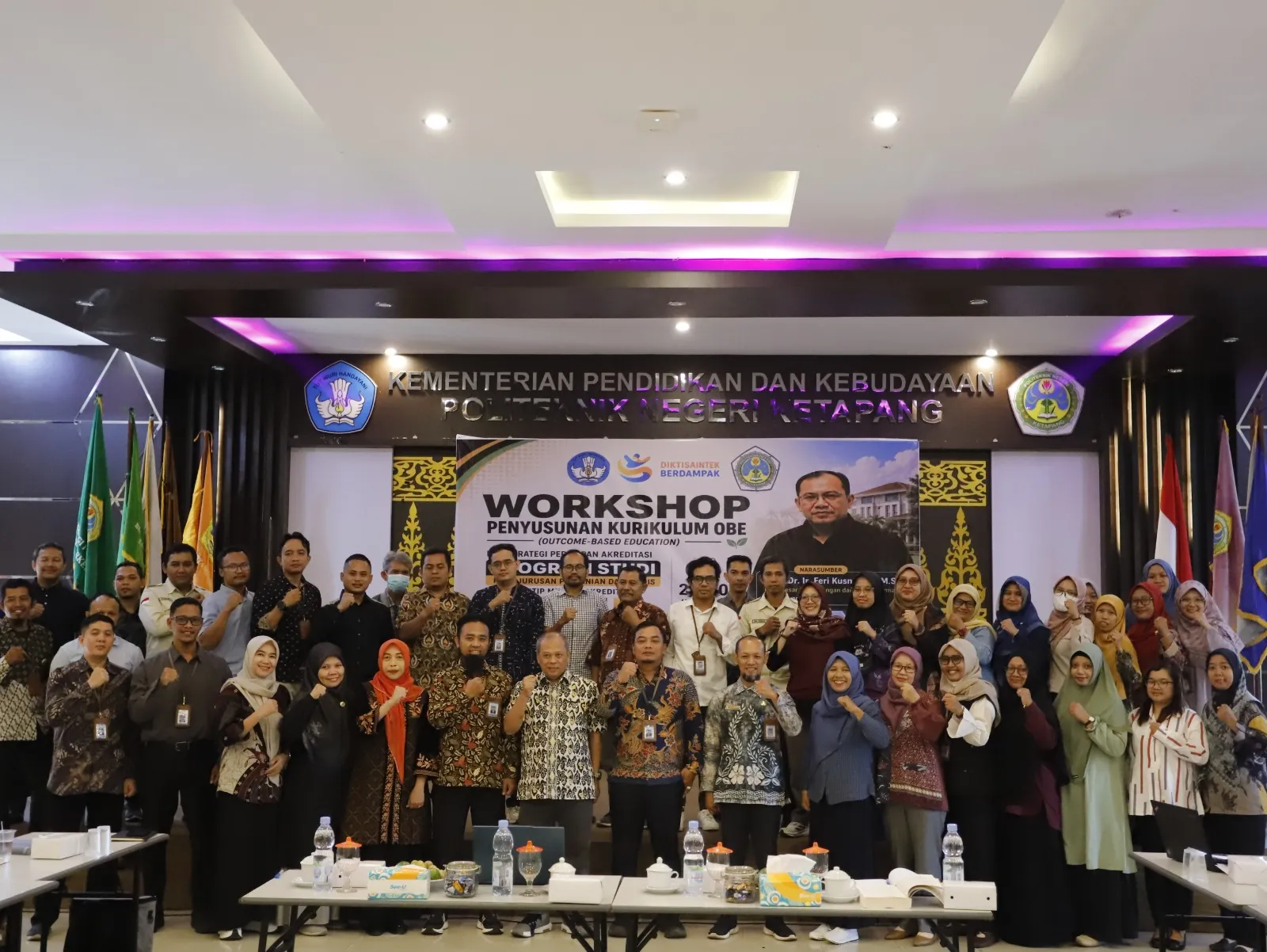
Ketapang, 29–30 July 2026 – Politeknik Negeri Ketapang (Ketapang State Polytechnic) (Ketapang State Polytechnic, POLITAP) held a Workshop on Outcome-Based Education (OBE) Curriculum Development and Study Program Accreditation Preparation Strategies at LAM-PTIP Towards Excellent Accreditation for two days, on 29–30 July 2026, at the 2nd Floor Directorate Building Hall. This event featured guest speaker Prof. Dr. Ir. Feri Kusnandar, M.Sc. from IPB University and was attended by lecturers and study program teams within the Department of Agriculture and Business.
The workshop was officially opened by the Director of Politeknik Negeri Ketapang, Irianto SP., S.ST., M.MA. In his opening remarks, he emphasized that higher education institutions today are no longer merely expected to produce graduates who master knowledge, but also graduates who possess competence, character, adaptability, and the ability to provide solutions to various challenges in the workforce and society. Therefore, curriculum transformation through the Outcome-Based Education (OBE) approach has become an urgent necessity that cannot be delayed.
The Director explained that implementing OBE is a strategic step to ensure that the entire educational process is oriented toward measurable learning outcomes, relevant to industrial needs, and aligned with advancements in science and technology. Through this approach, graduates of Politeknik Negeri Ketapang are expected to have competencies suited to modern demands and capable of competing at both national and international levels.
Furthermore, he stated that this workshop serves as a crucial momentum for the Department of Agriculture and Business to align perceptions, strengthen understanding, and develop a curriculum that not only meets national standards but also addresses stakeholder expectations. The Director also reminded that accreditation is not the ultimate goal, but rather the consequence of a commitment to fostering a sustainable culture of quality. According to him, the success of quality improvement can only be achieved through collaboration, commitment, and synergy across the entire academic community.
On the first day, participants received material regarding the development of the Outcome-Based Education (OBE) Curriculum. The speaker explained the basic concepts of OBE, the formulation of graduate learning outcomes (CPL), course mapping, and implementation strategies for learning outcome-oriented curricula. Following the presentation session, participants proceeded with discussions and the drafting of curriculum documents within their respective study programs as an implementation of the insights gained.
Meanwhile, on the second day, the workshop focused on the topic “Accreditation Preparation Strategies at LAM-PTIP Towards Excellent Accreditation.” In this session, Prof. Dr. Ir. Feri Kusnandar, M.Sc. presented strategies for preparing evidence-based accreditation documents, fulfilling LAM-PTIP assessment criteria, and the importance of fostering a sustainable quality culture within study programs. Participants also discussed strategic steps to enhance the quality of governance, learning processes, research, community service, and tridharma outputs as part of the accreditation assessment indicators.
Throughout the two days, the workshop proceeded interactively with various discussion sessions and practical document drafting. This activity is expected to yield an implementable curriculum aligned with OBE principles while strengthening the readiness of study programs in facing the accreditation process at LAM-PTIP.
Through this workshop, Politeknik Negeri Ketapang reaffirmed its commitment to enhancing the quality of vocational education through strengthening learning outcome-based curricula and fostering a sustainable culture of quality. The results of this activity are expected to serve as a solid foundation in realizing study programs that are excellent, adaptive, and competitive, capable of producing graduates suited to workforce demands and industrial developments.